


Engine Compartment Overview
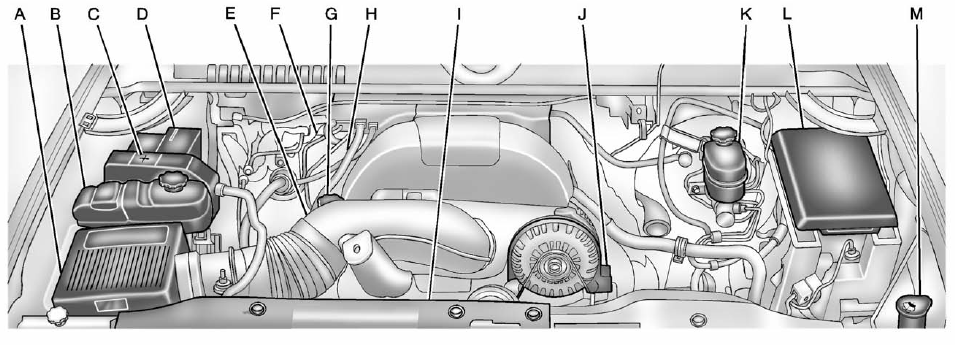
5.3 L V8 Engine Shown (4.3 L V6 Engine, 4.8 L V6 Engine, 6.0 L V8 Engine, and
6.2 L V8 Engine Similar)
A. Engine Air Cleaner/Filter on page 10‑17.
B. Coolant Surge Tank and Pressure Cap. See Cooling System on page 10‑19.
C. Positive (+) Terminal. See Jump Starting on page 10‑92.
D. Battery on page 10‑31.
E. Remote Negative (−) Terminal (Out of View). See Jump Starting on page
10‑92.
F. Automatic Transmission Dipstick (Out of View). See “Checking the Fluid Level”
under Automatic Transmission Fluid (4-Speed Transmission) on page 10‑11 or
Automatic Transmission Fluid (6-Speed Transmission) on page 10‑14.
G. Engine Oil Fill Cap. See “When to Add Engine Oil” under Engine Oil on page
10‑7.
H. Engine Oil Dipstick (Out of View). See “Checking Engine Oil” under Engine Oil
on page 10‑7.
I. Engine Cooling Fan (Out of View). See Cooling System on page 10‑19.
J. Power Steering Fluid Reservoir. See Power Steering Fluid on page 10‑27.
K. Brake Master Cylinder Reservoir. See Brake Fluid on page 10‑30.
L. Engine Compartment Fuse Block on page 10‑47.
M. Windshield Washer Fluid Reservoir. See “Adding Washer Fluid” under Washer
Fluid on page 10‑28.
If the vehicle has a diesel engine and/or an Allison Transmission, see the Duramax Diesel Supplement.
See also:
Wheel Replacement
Replace any wheel that is bent, cracked, or badly rusted or corroded. If wheel nuts keep coming loose, the wheel, wheel bolts, and wheel nuts should be replaced.
If the wheel leaks air, replace it.
...
Towing the Vehicle
Notice: To avoid damage, the disabled vehicle should be towed with all four wheels
off the ground. Care must be taken with vehicles that have low ground clearance
and/or special equipment. Always ...
Cold Check Procedure
Use this procedure only as a reference to determine if the transmission has enough fluid to be operated safely until a hot check procedure can be made. The hot check procedure is the most accurate met ...