

Cooling System
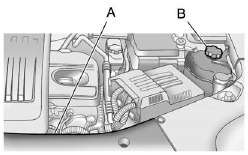
2.4L L4 Engine
A. Engine Cooling Fan (Out of View)
B. Engine Coolant Surge Tank and Pressure Cap
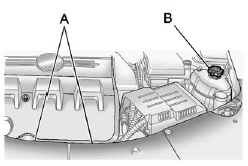
3.0L V6 Engine
A. Engine Cooling Fans (Out of View)
B. Engine Coolant Surge Tank and Pressure Cap
WARNING
An electric engine cooling fan under the hood can start up even when the engine is not running and can cause injury. Keep hands, clothing, and tools away from any underhood electric fan.
If the coolant inside the coolant surge tank is boiling, do not do anything else until it cools down. The vehicle should be parked on a level surface.
The coolant level should be at the COLD FILL line. If it is not, the vehicle may have a leak at the radiator hoses, heater hoses, radiator, water pump, or somewhere else in the cooling system.
WARNING
Heater and radiator hoses, and other engine parts, can be very hot. Do not touch
them. If you do, you can be burned.
Do not run the engine if there is a leak. If you run the engine, it could lose all
coolant. That could cause an engine fire, and you could be burned. Get any leak
fixed before you drive the vehicle.
If there seems to be no leak, with the engine on, check to see if the electric engine cooling fan is running. If the engine is overheating, the fan should be running. If it is not, the vehicle needs service. Turn off the engine.
Notice: Using coolant other than DEX-COOL® can cause premature engine, heater core, or radiator corrosion. In addition, the engine coolant could require changing sooner, at 50 000 km (30,000 mi) or 24 months, whichever occurs first. Any repairs would not be covered by the vehicle warranty. Always use DEX-COOL (silicate-free) coolant in the vehicle.
See also:
Add-On Electrical Equipment
Notice: Do not add anything electrical to the vehicle unless you check with your
dealer first. Some electrical equipment can damage the vehicle and the damage would
not be covered by the vehicle&# ...
Climate Control Systems (with Heater Only)
With this system the heating and ventilation can be controlled.
A. Fan Control
B. Temperature Control
C. Air Delivery Mode Control
Temperature Control: Turn clockwise or counterclockwise to incre ...
Low Fuel Warning Light
English Shown, Metric Similar
This light comes on for a few seconds when the ignition is turned on as a check
to indicate it is working. If it does not come on, have it fixed.
The low fuel warni ...