


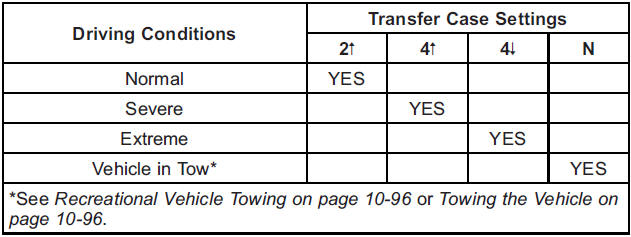
Recommended Transfer Case Settings
Notice: Driving on clean, dry pavement in four-wheel drive for an extended period of time can cause premature wear on the vehicle's powertrain. Do not drive on clean, dry pavement in Four-Wheel Drive for extended periods of time.
4  (Four-Wheel Drive Low): This setting also engages the front axle and delivers extra torque. You may never need Four-Wheel Drive Low.
It sends maximum power to all four wheels. You might choose Four-Wheel Drive Low if you are driving off-road in deep sand, deep mud, deep snow, and while climbing or descending steep hills.
If the vehicle has StabiliTrak®, shifting into Four-Wheel Drive Low will turn Traction Control and StabiliTrak off. See StabiliTrak® System on page 9‑59.

A parking brake symbol is located next to the N (Neutral) symbol as a reminder to set the parking brake before shifting the transfer case into N (Neutral).
WARNING
Shifting the transfer case to N (Neutral) can cause the vehicle to roll even if the transmission is in P (Park). You or someone else could be seriously injured. Be sure to set the parking brake before placing the transfer case in N (Neutral). See Parking Brake on page 9‑58.
N (Neutral): Shift to this setting only when the vehicle needs to be towed. See Recreational Vehicle Towing on page 10‑96 or Towing the Vehicle on page 10‑96.
2  (Two-Wheel Drive High): This setting is used for driving in most street and highway situations.
The front axle is not engaged in two-wheel drive. This setting also provides the best fuel economy.
4 (Four-Wheel Drive High): Use this setting when you need extra traction, such as on snowy or icy roads or in most off-road situations.
This setting also engages the front axle to help drive your vehicle. This is the best setting to use when plowing snow.
You can shift from Two-Wheel Drive High to Four-Wheel Drive High or Four-Wheel Drive High to Two-Wheel Drive High while the vehicle is moving. In extremely cold weather, it may be necessary to stop or slow the vehicle to shift into Four-Wheel Drive High.
See also:
Highway Hypnosis
Always be alert and pay attention to your surroundings while driving.
If you become tired or sleepy, find a safe place to park the vehicle and rest.
Other driving tips include:
• Keep the vehicle ...
Using ABS
Do not pump the brakes. Just hold the brake pedal down firmly and let ABS work.
You might hear the ABS pump or motor operating and feel the brake pedal pulsate,
but this is normal. ...
Making a Call
Calls can be made using the following commands.
Dial or Call: The dial or call command can be used interchangeably to dial a phone number or a stored name tag.
Digit Dial: This command allows a phon ...