


Older Children
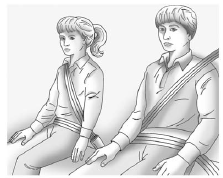
Older children who have outgrown booster seats should wear the vehicle safety belts.
The manufacturer's instructions that come with the booster seat state the weight and height limitations for that booster. Use a booster seat with a lap-shoulder belt until the child passes the fit test below:
○ Sit all the way back on the seat. Do the knees bend at the seat edge? If yes,
continue. If no, return to the booster seat.
○ Buckle the lap-shoulder belt. Does the shoulder belt rest on the shoulder? If
yes, continue. If no, try using the rear safety belt comfort guide. See “Rear Safety
Belt Comfort Guides” under Lap-Shoulder Belt on page 3‑15 for more information.
If the shoulder belt still does not rest on the shoulder, then return to the booster
seat.
○ Does the lap belt fit low and snug on the hips, touching the thighs? If yes, continue.
If no, return to the booster seat.
○ Can proper safety belt fit be maintained for the length of the trip? If yes, continue.
If no, return to the booster seat.
Q: What is the proper way to wear safety belts?
A: An older child should wear a lap-shoulder belt and get the additional restraint a shoulder belt can provide. The shoulder belt should not cross the face or neck. The lap belt should fit snugly below the hips, just touching the top of the thighs. This applies belt force to the child's pelvic bones in a crash. It should never be worn over the abdomen, which could cause severe or even fatal internal injuries in a crash.
Also see “Rear Safety Belt Comfort Guides” under Lap-Shoulder Belt on page 3‑15.
According to accident statistics, children and infants are safer when properly restrained in a child restraint system or infant restraint system secured in a rear seating position.
In a crash, children who are not buckled up can strike other people who are buckled up, or can be thrown out of the vehicle. Older children need to use safety belts properly.
WARNING
Never do this.
Never allow two children to wear the same safety belt. The safety belt cannot properly spread the impact forces. In a crash, the two children can be crushed together and seriously injured. A safety belt must be used by only one person at a time.
WARNING
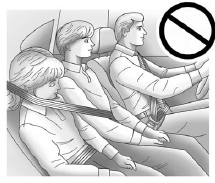
Never do this.
Never allow a child to wear the safety belt with the shoulder belt behind their back. A child can be seriously injured by not wearing the lap-shoulder belt properly. In a crash, the child would not be restrained by the shoulder belt. The child could move too far forward increasing the chance of head and neck injury. The child might also slide under the lap belt. The belt force would then be applied right on the abdomen. That could cause serious or fatal injuries. The shoulder belt should go over the shoulder and across the chest.
See also:
Sun Visors
Sun Visors
Pull the sun visor down to block glare. Detach the sun visor from the center mount to pivot to the side window, or to extend along the rod, if available. ...
OnStar®
If the vehicle is equipped with an active OnStar system, that system may also record data in crash or near crash-like situations.
The OnStar Terms and Conditions provides information on data collecti ...
Other ITBC-Related DIC Messages
In addition to displaying TRAILER GAIN and TRAILER OUTPUT through the DIC, trailer connection and ITBC system status are displayed on the DIC.
TRAILER CONNECTED: This message will be briefly displaye ...