


Front Seats
The vehicle's front seats have head restraints in the outboard seating positions.
WARNING
With head restraints that are not installed and adjusted properly, there is a greater chance that occupants will suffer a neck/ spinal injury in a crash. Do not drive until the head restraints for all occupants are installed and adjusted properly.
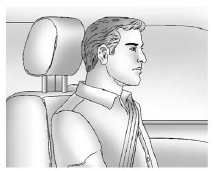
Adjust the head restraint so that the top of the restraint is at the same height as the top of the occupant's head. This position reduces the chance of a neck injury in a crash.
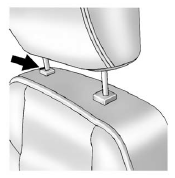
The height of the head restraint can be adjusted. Pull the head restraint up to raise it. Try to move the head restraint to make sure that it is locked in place.
To lower the head restraint, press the button, located on the top of the seatback, and push the head restraint down. Try to move the head restraint after the button is released to make sure that it is locked in place.
The front seat outboard head restraints are not designed to be removed.
See also:
Maintenance Replacement Parts
Replacement parts identified below by name, part number, or specification can
be obtained from your dealer.
If your vehicle has a diesel engine, see the Duramax diesel supplement for more
informa ...
Finding a Category (CAT) Station
To find XM channels in a category:
1. Press the CAT button to display the category tabs. Continue pressing the CAT button until the desired category name displays.
• Radios with CD and DVD can als ...
Programming the Universal Home Remote System
For questions or help programming the Universal Home Remote System, call 1-800-355-3515 or go to www.homelink.com.
Programming a garage door opener involves time-sensitive actions, so read the entire ...