


Tire Rotation
Tires should be rotated every 12 000 km (7,500 mi). See Maintenance Schedule on page 11‑3.
Tires are rotated to achieve a uniform wear for all tires. The first rotation is the most important.
Any time unusual wear is noticed, rotate the tires as soon as possible and check the wheel alignment. Also check for damaged tires or wheels. See When It Is Time for New Tires on page 10‑71 and Wheel Replacement on page 10‑76.
If your vehicle has dual rear wheels, also see Dual Tire Rotation on page 10‑71.
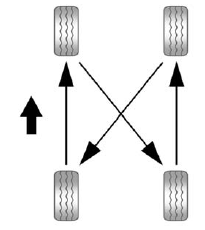
Use this rotation pattern when rotating the tires if the vehicle has single rear wheels.
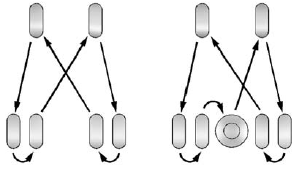
Use this rotation pattern when rotating the tires if the vehicle has dual rear wheels (except polished forged aluminum wheels).
Vehicles with polished forged aluminum dual wheels have three unique wheels; a front, a rear outer and a rear inner.
These wheels cannot be rotated to another position, however, they can be rotated from left to right to the same position.
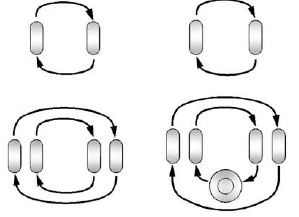
Use this rotation pattern when rotating the tires if the vehicle has polished forged aluminum dual rear wheels. The spare wheel can be used in any position and can be rotated with the rear inner wheels.
When installing dual wheels, check that the vent holes in the inner and outer wheels on each side are lined up.
Adjust the front and rear tires to the recommended inflation pressure on the Tire and Loading Information label after the tires have been rotated. See Tire Pressure on page 10‑62 and Vehicle Load Limits on page 9‑17.
Check that all wheel nuts are properly tightened. See “Wheel Nut Torque” under Capacities and Specifications on page 12‑2.
WARNING
Rust or dirt on a wheel, or on the parts to which it is fastened, can make wheel nuts become loose after time. The wheel could come off and cause an accident. When changing a wheel, remove any rust or dirt from places where the wheel attaches to the vehicle. In an emergency, a cloth or a paper towel can be used; however, use a scraper or wire brush later to remove all rust or dirt.
Lightly coat the center of the wheel hub with wheel bearing grease after a wheel change or tire rotation to prevent corrosion or rust build-up. Do not get grease on the flat wheel mounting surface or on the wheel nuts or bolts.
Reset the Tire Pressure Monitor System (TPMS), if the vehicle has one. See Tire Pressure Monitor Operation on page 10‑65.
Check that the spare tire, if the vehicle has one, is stored properly. Push, pull, and then try to rotate or turn the tire. If it moves, tighten the cable. See “Storing a Flat or Spare Tire and Tools” under Tire Changing on page 10‑80.
See also:
All-Wheel Drive
Vehicles with this feature always send engine power to all four wheels. It is
fully automatic, and adjusts itself as needed for road conditions.
When using a compact spare tire on an AWD vehicle, t ...
DVD-V (Video) Display Buttons
Once a DVD-V is inserted, the radio display menu shows several icons.
Press the softkeys under any icon during DVD playback. See the icon list below for more information.
A rear seat passenger can n ...