

Tire Sidewall Labeling
Useful information about a tire is molded into the sidewall. The examples show a typical passenger and light truck tire sidewall.
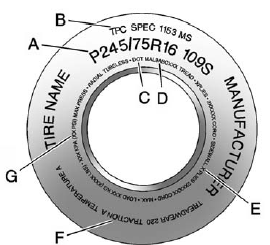
Passenger (P-Metric) Tire
(A) Tire Size: The tire size code is a combination of letters and numbers used to define a particular tire's width, height, aspect ratio, construction type, and service description. See the “Tire Size” illustration later in this section for more detail.
(B) TPC Spec (Tire Performance Criteria Specification): Original equipment tires designed to GM's specific tire performance criteria have a TPC specification code molded onto the sidewall.
GM's TPC specifications meet or exceed all federal safety guidelines.
(C) DOT (Department of Transportation): The Department of Transportation (DOT) code indicates that the tire is in compliance with the U.S. Department of Transportation Motor Vehicle Safety Standards.
(D) Tire Identification Number (TIN): The letters and numbers following the DOT code are the Tire Identification Number (TIN). The TIN shows the manufacturer and plant code, tire size, and date the tire was manufactured. The TIN is molded onto both sides of the tire, although only one side may have the date of manufacture.
(E) Tire Ply Material: The type of cord and number of plies in the sidewall and under the tread.
(F) Uniform Tire Quality Grading (UTQG): Tire manufacturers are required to grade tires based on three performance factors: treadwear, traction, and temperature resistance. For more information, see Uniform Tire Quality Grading on page 10‑74.
(G) Maximum Cold Inflation Load Limit: Maximum load that can be carried and the maximum pressure needed to support that load. For information on recommended tire pressure see Tire Pressure on page 10‑62 and Vehicle Load Limits on page 9‑17.
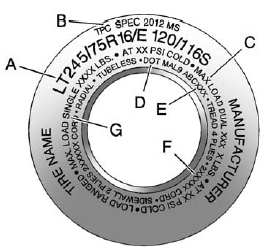
Light Truck (LT-Metric) Tire
(A) Tire Size: The tire size code is a combination of letters and numbers used to define a particular tire's width, height, aspect ratio, construction type, and service description. See the “Tire Size” illustration later in this section for more detail.
(B) TPC Spec (Tire Performance Criteria Specification): Original equipment tires designed to GM's specific tire performance criteria have a TPC specification code molded onto the sidewall.
GM's TPC specifications meet or exceed all federal safety guidelines.
(C) Dual Tire Maximum Load:
Maximum load that can be carried and the maximum pressure needed to support that load when used in a dual configuration. For information on recommended tire pressure see Tire Pressure on page 10‑62 andVehicle Load Limits on page 9‑17.
(D) DOT (Department of Transportation): The Department of Transportation (DOT) code indicates that the tire is in compliance with the U.S. Department of Transportation Motor Vehicle Safety Standards.
(E) Tire Identification Number (TIN): The letters and numbers following the DOT code are the Tire Identification Number (TIN).
The TIN shows the manufacturer and plant code, tire size, and date the tire was manufactured. The TIN is molded onto both sides of the tire, although only one side may have the date of manufacture.
(F) Tire Ply Material: The type of cord and number of plies in the sidewall and under the tread.
(G) Single Tire Maximum Load: Maximum load that can be carried and the maximum pressure needed to support that load when used as a single. For information on recommended tire pressure see Tire Pressure on page 10‑62 and Vehicle Load Limits on page 9‑17.
See also:
Clearing the System
Unless information is deleted out of the in-vehicle Bluetooth system, it will
be retained indefinitely. This includes all saved name tags in the phone book and
phone pairing information. For infor ...
Manual Operation
(Power): Press to turn the climate
control system on or off.
(Fan Control): Turn to increase
or decrease the fan speed. Adjusting the fan speed while in automatic mode places
the fan under ma ...
Manual Rearview Mirror
Hold the mirror in the center to move it for a clearer view of behind your vehicle. Adjust the mirror to avoid glare from the headlamps behind you. Push the tab at the bottom of the mirror forward for ...