


Cooling System
If the vehicle has the Duramax® Diesel engine, see the Duramax® Diesel Supplement for more information.
The cooling system allows the engine to maintain the correct working temperature.
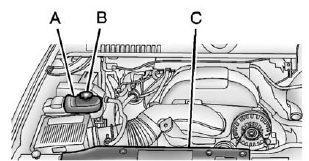
5.3 L Engine Shown (4.3 L, 4.8 L, 6.0 L and, 6.2 L Engines Similar)
A. Coolant Surge Tank
B. Coolant Surge Tank Pressure Cap
C. Engine Cooling Fan (Out of View)
WARNING
An electric engine cooling fan can start even when the engine is not running. To avoid injury, always keep hands, clothing, and tools away from any engine cooling fan.
WARNING
Heater and radiator hoses, and other engine parts, can be very hot. Do not touch them. If you do, you can be burned.
Do not run the engine if there is a leak. If you run the engine, it could lose all coolant. That could cause an engine fire, and you could be burned. Get any leak fixed before you drive the vehicle.
Notice: Using coolant other than DEX-COOL® can cause premature engine, heater core, or radiator corrosion. In addition, the engine coolant could require changing sooner, at 50 000 km (30,000 mi) or 24 months, whichever occurs first. Any repairs would not be covered by the vehicle warranty.
Always use DEX-COOL (silicate-free) coolant in the vehicle.
See also:
Overview
GMC Savana is engineered with an understanding of how you rely on a full-size
van to get the job done right – whether it’s transporting up to 15 people in
comfort in a Passenger Van, or moving ...
Fabric/Carpet
Start by vacuuming the surface using a soft brush attachment.
If a rotating brush attachment is being used during vacuuming, only use it on the floor carpet.
Before cleaning, gently remove as much o ...
Loading Points
A. Primary Load Points
B. Secondary Load Areas
C. Cargo Management Option Holes
Structural members (A) and (B) are included in the pick-up box design.
Additional accessories should use these loa ...