


Regular Cab Models
1. If the child restraint manufacturer recommends that the top tether be attached, attach and tighten the top tether to the top tether anchor, if your vehicle has one.
Refer to the child restraint instructions and the following steps:
1.1. Pull the passenger seatback forward by pulling the recliner handle upward to access the top tether anchor. See Reclining Seatbacks on page 3‑5 for additional information.
1.2. Find the top tether anchor.
1.3. Remove the cover to expose the anchor.
1.4. Route, attach, and tighten the top tether according to your child restraint instructions and the following instructions:
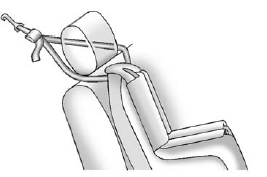
If the position you are using has an adjustable headrest or head restraint and you are using a dual tether, route the tether around the headrest or head restraint.
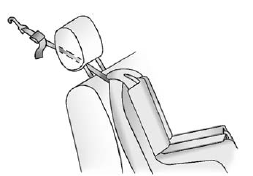
If the position you are using has an adjustable headrest or head restraint and you are using a single tether, raise the headrest or head restraint and route the tether under the headrest or head restraint and in between the headrest or head restraint posts.
2. See Securing Child Restraints (Rear Seat Position) on page 3‑60 or Securing Child Restraints (Center Front Seat Position) on page 3‑62 or Securing Child Restraints (Right Front Seat Position) on page 3‑62 for instructions on installing the child restraint using the safety belts.
3. Before placing a child in the child restraint, make sure it is securely held in place. To check, grasp the child restraint at the LATCH path and attempt to move it side-to-side and backand- forth. There should be no more than 2.5 cm (1 in) of movement for proper installation.
See also:
Making Turns
Notice: Making very sharp turns while trailering could cause the trailer to come
in contact with the vehicle. The vehicle could be damaged. Avoid making very sharp
turns while trailering.
When tu ...
Trailer Brakes
A loaded trailer that weighs more than 450 kg (1,000 lbs) needs to have its own brake system that is adequate for the weight of the trailer. Be sure to read and follow the instructions for the trailer ...
Vehicle Load Limits
It is very important to know how much weight your vehicle can carry. This weight is called the vehicle capacity weight and includes the weight of all occupants, cargo, and all nonfactory-installed opt ...