


Cooling System
If the vehicle has the Duramax® Diesel engine, see the Duramax® Diesel Supplement for more information.
The cooling system allows the engine to maintain the correct working temperature.
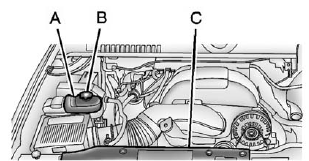
5.3 L Engine Shown (4.3 L, 4.8 L, 6.0 L and, 6.2 L Engines Similar)
A. Coolant Surge Tank
B. Coolant Surge Tank Pressure Cap
C. Engine Cooling Fan (Out of View)
WARNING
An electric engine cooling fan can start even when the engine is not running. To avoid injury, always keep hands, clothing, and tools away from any engine cooling fan.
WARNING
Heater and radiator hoses, and other engine parts, can be very hot. Do not touch them. If you do, you can be burned.
Do not run the engine if there is a leak. If you run the engine, it could lose all coolant. That could cause an engine fire, and you could be burned. Get any leak fixed before you drive the vehicle.
Notice: Using coolant other than DEX-COOL® can cause premature engine, heater core, or radiator corrosion. In addition, the engine coolant could require changing sooner, at 50 000 km (30,000 mi) or 24 months, whichever occurs first. Any repairs would not be covered by the vehicle warranty.
Always use DEX-COOL (silicate-free) coolant in the vehicle.
See also:
Air Vents
Use the air outlets, located in the center and on the side of the instrument
panel, to direct the airflow. Use the thumbwheels located near the center air outlets,
to open or close off the airflow ...
Power Door Locks
Base Model
Uplevel Model
(Unlock): Press to unlock the doors.
(Lock): Press to lock the
doors. ...
Wheel Alignment
Wheel alignment is critical for ensuring that the tires deliver optimal wear and performance.
• Signs that the alignment may need to be adjusted include pulling, improper vehicle handling, or unusu ...