


Steps for Determining Correct Load Limit
1. Locate the statement “The combined weight of occupants and cargo should never exceed XXX kg or XXX lbs” on your vehicle's placard.
2. Determine the combined weight of the driver and passengers that will be riding in your vehicle.
3. Subtract the combined weight of the driver and passengers from XXX kg or XXX lbs.
4. The resulting figure equals the available amount of cargo and luggage load capacity.
For example, if the “XXX” amount equals 1400 lbs and there will be five 150 lb passengers in your vehicle, the amount of available cargo and luggage load capacity is 650 lbs (1400−750 (5x150) = 650 lbs).
5. Determine the combined weight of luggage and cargo being loaded on the vehicle.
That weight may not safely exceed the available cargo and luggage load capacity calculated in Step 4.
6. If your vehicle will be towing a trailer, the load from your trailer will be transferred to your vehicle. Consult this manual to determine how this reduces the available cargo and luggage load capacity of your vehicle. SeeTrailer Towing on page 9‑84 for important information on towing a trailer, towing safety rules and trailering tips.
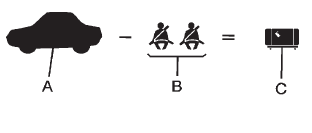
Example 1
A. Vehicle Capacity Weight for Example 1 = (453 kg) (1,000 lbs)
B. Subtract Occupant Weight @ 68 kg (150 lbs) × 2 = 136 kg (300 lbs)
C. Available Occupant and Cargo Weight = 317 kg (700 lbs)
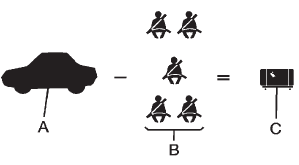
Example 2
A. Vehicle Capacity Weight for Example 2 = 453 kg (1,000 lbs)
B. Subtract Occupant Weight @ 68 kg (150 lbs) × 5 = 340 kg (750 lbs)
C. Available Cargo Weight = 113 kg (250 lbs)
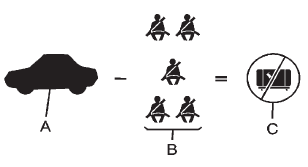
Example 3
A. Vehicle Capacity Weight for Example 3 = 453 kg (1,000 lbs)
B. Subtract Occupant Weight @ 91 kg (200 lbs) × 5 = 453 kg (1,000 lbs)
C. Available Cargo Weight = 0 kg (0 lbs)
Refer to your vehicle's tire and loading information label for specific information about your vehicle's capacity weight and seating positions. The combined weight of the driver, passengers, and cargo should never exceed your vehicle's capacity weight.
See also:
Engine Oil Pressure Light
WARNING
Do not keep driving if the oil pressure is low. The engine can become so hot that it catches fire.
Someone could be burned. Check the oil as soon as possible and have the vehicle serviced.
...
Airbag System Check
The airbag system does not need regularly scheduled maintenance or replacement. Make sure the airbag readiness light is working. See Airbag Readiness Light on page 5‑20 for more information.
No ...
Engine Compartment Fuse Block
The underhood fuse block is located in the engine compartment, on the passenger side of the vehicle.
Lift the cover for access to the fuse/relay block.
Notice: Spilling liquid on any electrical co ...